
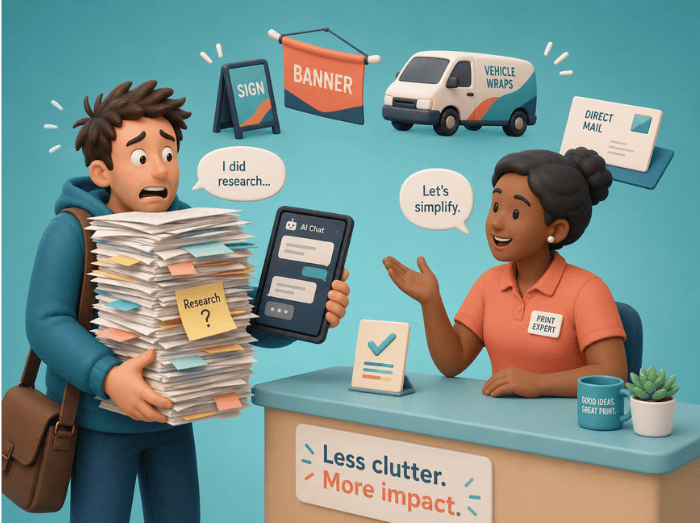
AI has changed how print buyers learn before they contact you.For years, many print businesses could rely on the first sales conversation to educate the customer. A buyer would call, email, or fill out a quote form. Your sales rep, CSR, estimator, or owner would ask the right questions, explain the options, clarify the specs, and help the customer understand what was realistic.That conversation still matters. But it is no longer always the first step.Today, your customer may already have asked ChatGPT what material they need for an outdoor sign. They may have watched a video about vehicle wraps. They may have compared promotional product ideas in an AI-generated list. They may have searched for “best direct mail ideas for dentists” or “how much does monument signage cost?” before they ever contacted your company.They may arrive more informed. They may also arrive more confused. That’s the shift.
AI has not made the print sales process simpler. It has moved part of the buyer’s education process upstream, before your team is involved. Customers may now show up with more information, more assumptions, and less patience for vague communication. Some of what they learned may be useful. Some of it may be wrong. Either way, your team has to be ready.
The New First Impression Happens Before the Phone Rings
In the past, the buyer journey was easier to picture. A customer needed something printed, mailed, wrapped, installed, branded, or produced. They searched for a provider, asked for a quote, and then the sales process began.
Now, discovery is messier. A buyer might learn about your company through Google, LinkedIn, AI Overviews, ChatGPT, YouTube, Reddit, a referral, an email, a review site, or a competitor’s content. They may compare you before they click. They may form an opinion before they speak to anyone.
That opinion may be shaped by the clarity of your website, the helpfulness of your content, the specificity of your examples, the quality of your reviews, and the confidence of your first response.
This matters because print is not a simple commodity business, even when customers try to treat it like one. A banner is not just a banner. A sign is not just a sign. A direct mail campaign is not just ink on paper. A promo order is not just “put my logo on this thing.”Every project carries variables: size, surface, substrate, finishing, installation, mailing rules, artwork quality, data quality, timing, quantity, durability, compliance, budget, intended use, and customer expectations. When buyers research before they call, they may understand some of these variables. But they may also misunderstand them.
That creates a new burden for your team. You are not just selling the job. You are correcting, guiding, translating, and sometimes gently undoing assumptions the buyer picked up before they reached you.
More Informed Does Not Always Mean Better Prepared
There is a difference between a customer who has done useful research and a customer who has collected fragments. This is not the customer’s fault. They are trying to make a good decision with the tools available to them.But fast answers are not always complete answers…A customer might learn that aluminum composite material is common for outdoor signage, but not understand whether it is right for their site, mounting method, wind exposure, design, local code, or budget. A buyer might ask AI for “best promotional products for a trade show,” but not understand decoration methods, inventory issues, lead times, freight, minimums, or brand fit.So the buyer arrives with confidence, but not necessarily context. The companies that win in this environment will not be the ones that simply say, “Sure, we can quote that.” They will be the ones that help customers make sense of what they think they know.
The Opportunity Is Customer Clarity
This is where AI-era marketing and sales measurement need to change. The old question was, “How many people clicked?” Then it became, “How many people filled out the form?” But for print, signage, promo, and direct mail companies, those questions are incomplete.A better question is: Are we creating clearer, better-informed, better-fit customers?That may sound softer than traffic or clicks, but it is often more valuable. A customer who understands what information you need is easier to serve. A customer who understands the difference between cheap and appropriate is less likely to shop only on price. A customer who understands why timeline matters is more likely to respect production realities. A customer who understands artwork requirements creates less rework.Your marketing should not just create attention. It should reduce confusion. Your sales process should not just respond to inquiries. It should guide buyers toward better decisions. Your AI strategy should not just help your team produce more content. It should help your business turn internal expertise into clearer customer experiences.
What to Measure Instead
Website traffic, search visibility, social engagement, and email performance still matter. But for a modern print business, especially one dealing with custom work, you also need to measure the quality of customer understanding.That may include inquiry completeness, clarification loops, inquiry-to-estimate rate, estimate-to-order rate, common misunderstanding patterns, time to first meaningful response, and customer education gaps. What do customers repeatedly get wrong about artwork, materials, timing, installation, mailing, promo sourcing, or pricing?These metrics matter because they connect marketing to operations. A vague inquiry creates a CSR problem, a sales problem, an estimating problem, and sometimes a production problem. If your marketing attracts attention but leaves the customer confused, the cost shows up somewhere else in the business. Usually, it shows up as labor.
AI Should Help Customers Buy Better
This is one of the most practical uses of AI for print businesses. Not replacing your sales team. Not pretending AI can estimate every job. Not letting a chatbot make promises your production team cannot keep.The better use is helping your business communicate more clearly, more consistently, and more quickly.AI can help create customer-friendly explanations of product options, better quote-request forms, smarter intake questions, first-response email templates, educational website copy, FAQs based on actual customer confusion, sales scripts, internal knowledge tools, missing-information checklists, and follow-up emails that explain next steps clearly.If your team repeatedly receives incomplete requests for signs, AI can help build a smarter intake process that asks about size, location, installation, viewing distance, artwork status, deadline, and intended use. If your sales team repeatedly explains why a file is not production-ready, AI can help create a customer-friendly explanation that is clear without sounding condescending.The value is not simply that AI writes faster. The value is that it helps your team standardize expertise that may currently live in a few people’s heads.
The Hidden Risk: Inconsistent Answers
Many print businesses have a quiet consistency problem. The owner explains the company one way. The senior sales rep explains it another way. The CSR has their own version. The website says something else. This is normal because print businesses are busy, custom, and full of tribal knowledge. But in the AI era, inconsistency becomes more expensive.Your team needs shared language for common customer questions: what affects price, what affects turnaround, what information is needed before quoting, what “print-ready artwork” means, and when a site survey is required. AI can help build that shared language, but only if it is grounded in your real business, your real services, your real customer issues, and your real standards.
The New Competitive Advantage
The print companies that benefit most from AI will not necessarily be the companies that use the most tools. They will be the companies that use AI to make their business easier to buy from.Can customers understand what you do? Can they tell what information you need? Can your team explain options clearly? Can you turn a vague request into a structured conversation? Can you reduce back-and-forth before the quote?These are not abstract AI questions. They are business questions. They affect speed, trust, margin, customer experience, and team capacity.
Where SharedIntel AI Fits
SharedIntel AI helps print, signage, promo, direct mail, wide-format, and graphic communications companies prepare for this new buyer journey. Not by turning your team into AI experts. Not by burying your staff in tool tutorials. Not by giving you generic prompts that sound impressive but do not match how print work actually moves through the business.We help translate the expertise already inside your company into practical AI-supported workflows your team can use. That can include smarter inquiry intake, customer education content, better first-response templates, sales enablement tools, internal knowledge bases, quote-prep workflows, role-based AI training, and automation that reduces repetitive back-and-forth.
The benefit is not just internal efficiency. Your customers feel it. They get clearer answers. They understand their options faster. They know what information to provide. They feel guided instead of processed. They have a smoother path from interest to decision.Your team benefits too: fewer messy quote requests, fewer repeated explanations, less avoidable confusion, more consistent communication, better-fit opportunities, and more confidence in the sales process.AI has changed how buyers learn before they contact you. The question is whether your business is ready to meet a more informed, more impatient, and sometimes more confused customer with the clarity they now expect.
Starting point:
If you want a structured, print-specific way to build these workflows—without hype, without chaos—learn more about our ChatGPT A–Z Crash Course for Print Professionals by visiting www.sharedintelai.com/services. The shops that win in the next 5 years will not be the ones that simply work faster; they will be the ones that use AI to become more capable than they ever thought possible!