
Operational Excellence Isn’t the Same as Customer RetentionI
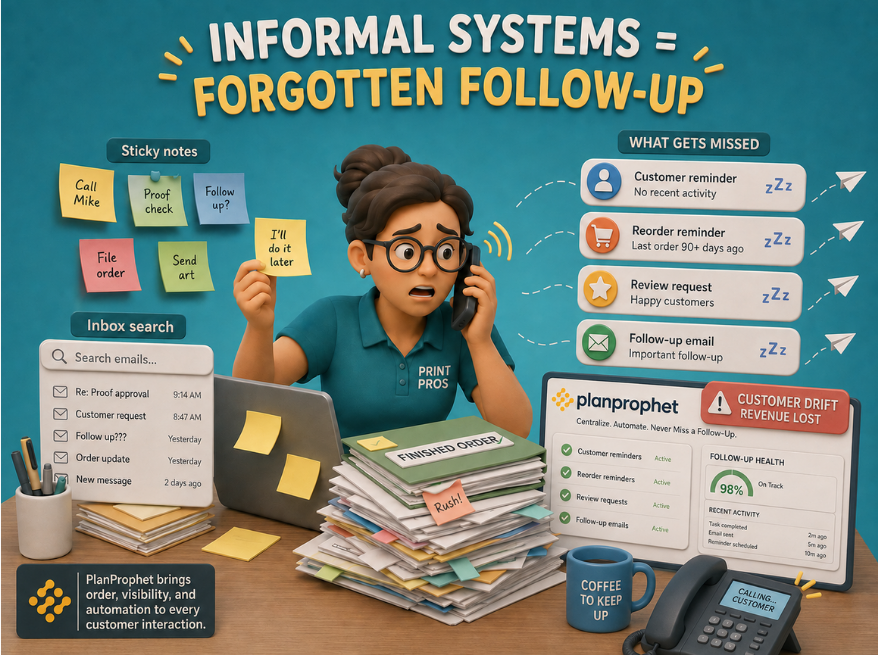
In the print industry, operational excellence has long been the benchmark of a well-run shop. Jobs go out on time. Equipment runs smoothly. Proofs are handled. Problems get solved. The customer receives what they ordered, often under tight deadlines.Yet many print businesses are still seeing a frustrating pattern: the job is completed successfully, the customer seems satisfied, and then… nothing. No reorder. No follow-up request. No expanded relationship. No obvious complaint, but no next opportunity.The work was done well, but the customer disappeared.That pattern is not usually caused by poor print quality or bad service. More often, it reflects a structural problem. The industry has historically put enormous operational discipline into production and delivery, while the systems required to maintain customer relationships have often remained informal, manual, or dependent on individual employees.In other words, the production workflow is engineered. The customer lifecycle often isn’t.
The Hidden Cost of Informal Systems
This gap becomes more expensive when teams are already stretched thin. Quoting, estimating, scheduling, proofing, production logistics, billing, and customer service all compete for attention. In that environment, follow-up outreach, reorder reminders, dormant-account check-ins, referral requests, and account expansion conversations are easy to postpone.And postponed often means forgotten.Recent industry research reinforces why this matters. In 2026, commercial printers are not simply dealing with a “busy season” problem. They are operating under sustained labor pressure, rising cost expectations, and growing demands for faster, more responsive service. Alliance Insights research reported by Printing Impressions found that 72% of printers struggle to hire production staff and 83% cite rising labor costs as a top concern. In that same environment, automation is increasingly being viewed not as a luxury, but as part of business resilience.
That does not mean every shop needs a complex technology overhaul. It does mean that relying on memory, inbox searches, sticky notes, and individual sales habits is becoming less defensible as an operating model.
A customer who does not hear from you after a successful job may not be unhappy. They may simply be busy. They may be approached by a competitor at the right moment. They may not know you also handle signage, direct mail, promo, labels, fulfillment, or recurring campaign support. Without a structured relationship system, the print provider is waiting for the customer to remember them.
That is not retention. That is hope.
Why Automation Is Entering the Conversation
Automation and AI-assisted workflows are becoming more relevant because they stabilize the operational foundation beneath customer relationships. The purpose is not to replace the human relationships that define successful print companies. It is to make those relationships more consistent.
When routine tasks such as follow-up reminders, outreach scheduling, lead tracking, review requests, reorder prompts, and proposal preparation are supported by automated systems, teams gain back time and cognitive bandwidth. Sales and customer service staff can spend less time reconstructing context and more time having useful conversations.
Automation does not eliminate work; it reorganizes it. A good system does not decide the strategy for the business. It helps the team consistently execute the strategy the business already knows it should be following.
Many print businesses know they should check in with a customer 60 or 90 days after a recurring order. They know certain customers reorder seasonal signage, event materials, branded merchandise, or direct mail campaigns on a predictable cycle. The issue is not lack of business intuition. The issue is that these opportunities are rarely organized into a repeatable system.
Automation turns those moments into triggers, reminders, tasks, and workflows. It keeps the relationship active even when the team is focused on the day’s production deadlines.
From Production Automation to Relationship Automation
Much of the print industry’s automation conversation has focused on production: prepress, scheduling, finishing, color management, web-to-print, estimating, and workflow integration. Those areas matter, and 2026 industry coverage continues to show connected automation becoming a major competitive advantage.
But customer-facing automation deserves equal attention.
A shop can have strong production systems and still lose value at the front end of the business. If estimates are not followed up on, if dormant customers are not reactivated, if satisfied clients are not asked for reviews or referrals, if sales activity is not visible, and if customer history is difficult to access, revenue can leak out quietly.
This is the front-office version of a bottleneck.The May 2026 FESPA Print Census findings are useful here because they show the gap between awareness and implementation. Automation is widely recognized as a way to improve efficiency, consistency, and scalability, but nearly half of print service providers reported having no automation in place. Smaller print businesses, in particular, often lack the internal capacity, knowledge, or infrastructure to implement new systems quickly.
That reality should shape how NPSOA members evaluate tools. The goal is not to chase software for its own sake. The goal is to identify where manual processes are creating preventable revenue loss, avoidable customer friction, or unnecessary staff burden.
Where PlanProphet Fits
A platform like PlanProphet is relevant because it is built specifically around the print industry’s front-office and customer-lifecycle problem. Rather than functioning only as a generic prospecting database, PlanProphet positions itself as a print-specific CRM and automation platform that connects with print MIS data and other operational inputs. That matters because much of the most useful customer relationship information in a print business is not sitting neatly inside a traditional CRM. It lives in estimates, order history, job patterns, invoices, customer activity, and account behavior.
PlanProphet’s own materials describe core capabilities including CRM, forecasting, customer experience automation, marketing automation, interactive reports, dashboards, automated billing, proofs management, collaboration, and mobile access. Its CRM messaging also emphasizes reminders, delegated tasks, access to customer order patterns, staff-to-customer communication tracking, and sales management visibility.
In April 2026, PlanProphet announced a networkwide agreement with Franchise Services, the franchisor behind Sir Speedy, PIP, and Signal Graphics. That announcement is notable because it reflects a broader shift: print organizations are not only looking for production efficiency; they are also investing in consistent front-office execution, proactive customer communication, clearer accountability, and more structured sales and marketing follow-through.
That is exactly the area where many independent shops feel the pain most acutely.
Choosing the Right Tool for Your Shop
Adopting automation tools is not simply a matter of installing software. The real value emerges when the system is aligned with the workflows, sales model, and growth priorities of the business.
For some shops, the first priority may be quote follow-up. For others, it may be reactivating dormant customers, standardizing sales handoffs, tracking reorder opportunities, improving collections communication, or creating more consistent marketing outreach.
No tool is universally right for every print operation. The better question is: where is inconsistency costing the business money?Print leaders evaluating PlanProphet or any comparable platform should begin with a practical internal review: Where do leads currently enter the business? Who follows up on estimates, and when? Which customers should be reordering but are not? Where does customer history live? Can the team easily identify the highest-value accounts? Are review requests, referral asks, and reactivation campaigns happening consistently? Which tasks depend on one person remembering to do them?
These questions reveal whether a shop has a customer lifecycle system or simply a collection of good intentions.

How You Can Evaluate PlanProphet
For businesses interested in exploring whether PlanProphet might be a good fit, the first step is not a demo. The first step is a lifecycle map.
Map the journey from initial inquiry to estimate, job, invoice, follow-up, reorder, and expanded relationship. Identify where work slows down, where communication becomes inconsistent, and where staff spend time manually reconstructing information that should be easy to access.
Then evaluate automation against those gaps.
A strong automation platform should help the team see what needs attention, act at the right time, and maintain a more consistent customer experience. It should make the business easier to manage, measure, and scale.
When implemented thoughtfully, automation creates a stronger operational backbone. It allows print teams to spend less time managing administrative friction and more time focusing on innovation, customer relationships, and growth opportunities. The technology itself is not the goal. The goal is building a business where strong systems support strong relationships.
Because the job being done well is no longer enough.
If the customer disappears after the job is complete, the business did not just lose a reorder. It lost a chance to become the customer’s trusted print partner.