
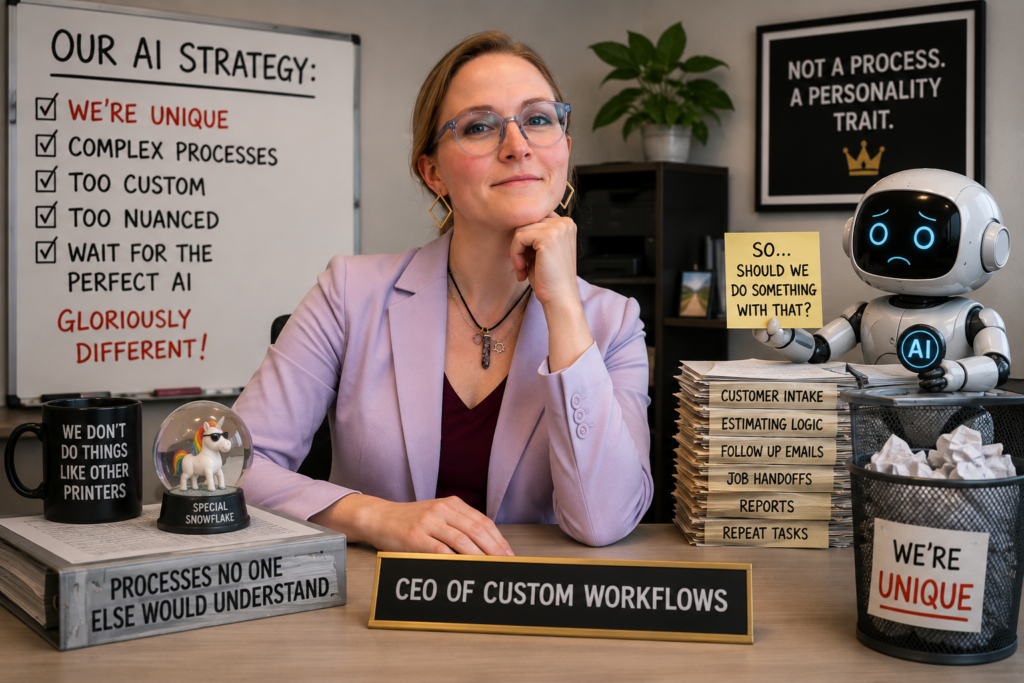
There is a phrase that appears in nearly every corner of the print industry.“We’re not like other companies.”Commercial printers say it. Sign shops say it. Promo distributors say it. Wide-format companies say it. Direct mail firms say it. Display producers say it. Franchise owners say it. Specialty manufacturers say it.Often, they are right.
Their customer mix is different. Their equipment is different. Their finishing process is different. Their estimating logic is different. Their sales cycle is different. Their team structure is different. Their product mix is different. Their internal workarounds are different. Their best people have developed judgment that cannot be fully captured in a generic workflow diagram.
But in the era of AI, “we’re unique” can become one of the most limiting beliefs in the business. Not because the company is wrong about being different. Because the conclusion is wrong.
Too many companies hear “AI” and assume the question is whether there is one standardized, industry-wide solution that perfectly matches their business.
When they cannot find that perfect solution, they stop.
They say, “That tool is not really built for us.”
“Our work is too custom.”
“Our back-end process is different.”
“Our jobs have too many variables.”
“Our estimating is too nuanced.”
“Our production logic is not like a normal print shop.”
“Our company is unique.”
Then they wait for a solution that somehow fits everyone else and also understands every exception inside their own operation. That is the wrong mental model.
AI is not powerful because it makes every company standard. AI is powerful because it can be configured around the specific logic of a company’s own work.
The problem is not uniqueness. The problem is vagueness.
Every serious print-industry company has nuance. That is not the obstacle.The obstacle is when the nuance has never been documented, structured, translated, or turned into operating rules.AI cannot help much with “our process is complicated.”It can help with: “When a customer requests a temporary display with incomplete specs, we first identify the likely use case, then determine whether structural design is required, then check whether prior comparable jobs exist, then estimate based on material, assembly method, packing requirements, and deadline risk.”
Those are very different inputs.
One is a claim of complexity.
The other is the beginning of a system.Many companies mistake undocumented expertise for true uniqueness. They assume that because a workflow lives in someone’s head, it cannot be supported by AI. In reality, that is exactly where AI work should often begin: by extracting, documenting, and systematizing how experienced people think.
AI does not need a company to become generic.It needs the company to articulate how it works.
“Unique” often means “we have not mapped the decision tree yet”
When a company says it is unique, the next question should be: unique where? Is the uniqueness in customer intake? Estimating? Substrate selection? Structural design? Proofing? Installation? Fulfillment? Assembly? Packing? Data processing? Mailing? Kitting? Sales strategy? Vendor coordination? Compliance? Customer communication?
Not all uniqueness is equal. Some of it is strategic differentiation. Some of it is operational complexity. Some of it is legacy process. Some of it is inefficiency wearing the costume of craftsmanship.
That distinction matters.
A company may have a highly specialized production process, but its customer follow-up might still be repetitive. Its proposal language might still be template-able. Its intake clarification might still follow patterns. Its sales research might still be automatable. Its recurring reports might still use the same format every month. Its internal SOPs might still be searchable. Its meeting notes might still be summarized. Its job handoffs might still benefit from structured briefs.
A business can be unique in its output and still very ordinary in its administrative drag.
That is the opportunity.
AI is not asking you to match the industry
A common fear is that adopting AI means adopting generic processes.This fear is understandable. Print companies have been sold plenty of software that required them to bend their business around a rigid platform. If the workflow did not fit, the company either forced a workaround or abandoned the tool.
AI changes that equation.The better use of AI is not to ask, “What is the standard workflow for companies like ours?”
The better question is, “How do we teach AI the way we already evaluate, decide, respond, estimate, qualify, communicate, and escalate?”
That does not mean every process should remain untouched. Some workflows are inefficient and should be improved. But AI implementation is not standardization for standardization’s sake.It is operational translation.It takes the way your company already works — including its judgment, constraints, preferences, risk flags, language, and decision points — and turns that into tools, prompts, knowledge bases, automations, review protocols, and repeatable workflows.
That is especially important in print, signage, promo, wide-format, direct mail, displays, and graphic communications because the work is rarely one-size-fits-all. Job variability is the norm. AI is useful precisely because it can handle context, compare inputs, summarize complexity, and help humans navigate variation more quickly.
The search for the perfect tool can delay the obvious work
Many companies spend too much time asking whether a tool exists for their exact niche.
That question has value. Industry-specific tools are increasingly important, and when a specialized platform solves a known bottleneck, it should be considered.
But the search for the perfect tool can become a delay tactic.
While leadership waits for the one platform that understands every internal exception, the team continues to lose time on work AI could already support:
Drafting customer clarification emails. Summarizing RFPs. Creating first-pass proposal language. Comparing new requests to past jobs. Cleaning CRM notes. Preparing meeting briefs. Creating job handoff summaries. Standardizing recurring reports. Turning expert walkthroughs into SOPs. Drafting quote follow-up sequences. Organizing internal knowledge. Flagging missing information before estimating begins.None of these require the company to become less unique. They require the company to stop treating uniqueness as a reason to avoid structure.
Custom does not mean unstructured
The print industry often uses “custom” and “unstructured” as though they are the same thing.
They are not.
A custom project can still have structured decision points.
A complex estimate can still have recurring variables.A specialized display can still have known material options, assembly questions, packing considerations, approval steps, and risk flags.
A signage job can still require predictable intake information: dimensions, surface, location, installation conditions, timeline, artwork availability, permitting concerns, viewing distance, and durability needs.
A promo campaign can still require audience, budget, quantity, event date, brand constraints, fulfillment requirements, and reorder potential.
A direct mail campaign can still require data source, list hygiene, personalization rules, postal class, creative assets, drop date, compliance review, and reporting expectations.The fact that final execution varies does not mean the front-end thinking is unknowable.
AI thrives in that middle space: not rigid enough for a simple checklist, but not so mysterious that only one veteran employee can interpret it.
Your uniqueness is an input, not an excuse
A company’s uniqueness should become training material for its AI systems.Its best estimates. Its strongest proposals. Its rejected jobs. Its customer objections. Its internal rules of thumb. Its preferred language. Its production constraints. Its quality standards. Its escalation rules. Its old project examples. Its most painful rework stories. Its most profitable job types. Its “never promise this without checking first” rules. Its “ask these five questions before quoting” rules. Its “this customer always cares about speed over price” notes.This is the material that makes AI useful. Not generic advice. Not broad industry theory. The company’s own operating intelligence.
But that intelligence has to be captured.If it stays scattered across inboxes, old estimates, individual memory, shared drive folders, and casual Slack or Teams messages, then the company’s uniqueness remains trapped. AI cannot reliably support what the organization itself has never made accessible.That is why AI implementation often becomes a knowledge-capture project before it becomes an automation project.
The real risk is not becoming generic. The real risk is staying manually unique.
There is a dangerous version of uniqueness in which every customer request requires reinvention.Every quote starts from scratch. Every handoff depends on who is working that day. Every proposal sounds different. Every customer update is manually written. Every exception requires a senior person. Every new employee learns by interruption. Every process improvement lives in conversation but never becomes documentation.
That kind of uniqueness does not protect differentiation. It creates fragility.
The business becomes dependent on memory, heroic effort, and individual workarounds. It may still produce excellent work, but excellence becomes harder to scale.
AI does not remove the need for expert judgment. It makes expert judgment easier to distribute.
A senior estimator’s logic can inform a missing-information checklist. A skilled salesperson’s phrasing can become an approved follow-up template. A production manager’s risk awareness can become a preflight review prompt. A structural designer’s intake questions can become a project qualification tool. A CSR’s best customer-service tone can become a drafting assistant.
The point is not to flatten the business. The point is to make its best thinking more available
Stop waiting for “the AI solution for companies like us”
There may never be a single solution that perfectly fits your exact business.
That should not be surprising. It should be liberating.
The future of AI in the print industry is not one universal button that solves every shop’s workflow. It is a layered approach:Use industry-specific tools where they solve known problems. Use existing platforms where they already sit inside daily work. Use automation to connect systems and reduce handoffs. Use custom AI workspaces to support repeatable knowledge work. Use training to help people prompt, review, challenge, and improve AI outputs. Use governance to protect data, quality, and customer trust. Use human expertise to decide what good looks like.
That layered approach is how AI becomes specific to the company.
The irony is that companies insisting they are too unique for AI are often still looking for a generic answer. They want a solution that understands their uniqueness without requiring them to define it.
That is not implementation. That is avoidance.
The better question: what should AI learn from us?
Instead of asking, “Is there an AI tool for our exact niche?” ask:What do our best people know that our systems do not? Which decisions do we make repeatedly? Which questions do we ask customers over and over? Which mistakes create the most rework? Which job types are most profitable? Which customer requests should trigger caution? Which tasks should always have human review? Which documents would help AI give better answers? Which workflows are repeatable enough to systematize? Which parts of our process are truly strategic, and which are just habit?
These questions turn uniqueness into architecture.
They help a company move from “AI does not understand us” to “we have not yet taught AI how our business works.”That is a much more useful position.
AI rewards companies that can explain themselves
In the past, a company could often survive with informal knowledge. The veteran knew. The owner knew. The estimator knew. The CSR knew. The production manager knew. The sales rep knew.But AI changes the value of documentation.
The companies that can explain themselves clearly will have an advantage. Not because they are less custom, but because they can convert their custom knowledge into repeatable systems.
They can build internal assistants around SOPs and prior jobs. They can automate first-pass communication. They can train new employees faster. They can reduce dependency on individual memory. They can respond to customers more consistently. They can preserve institutional knowledge before retirement, turnover, or growth stretches the team too thin. They can test new tools more intelligently because they know which workflow the tool is supposed to improve.
That is the shift.
The winner is not the company with the most generic process. The winner is the company with enough operational clarity to apply powerful tools to its own process.
Food for Thought
“We’re unique” may be true.
But it is not a roadmap.
The real question is whether your uniqueness is documented, teachable, searchable, repeatable, and available to the people and systems that need it.
AI does not require your company to become like everyone else. It requires you to understand your own business clearly enough to configure the technology around it.
So the next time someone says, “We’re too unique for AI,” consider a sharper response:
Are we truly too unique — or have we simply not yet translated the way we work into a system AI can help us scale?